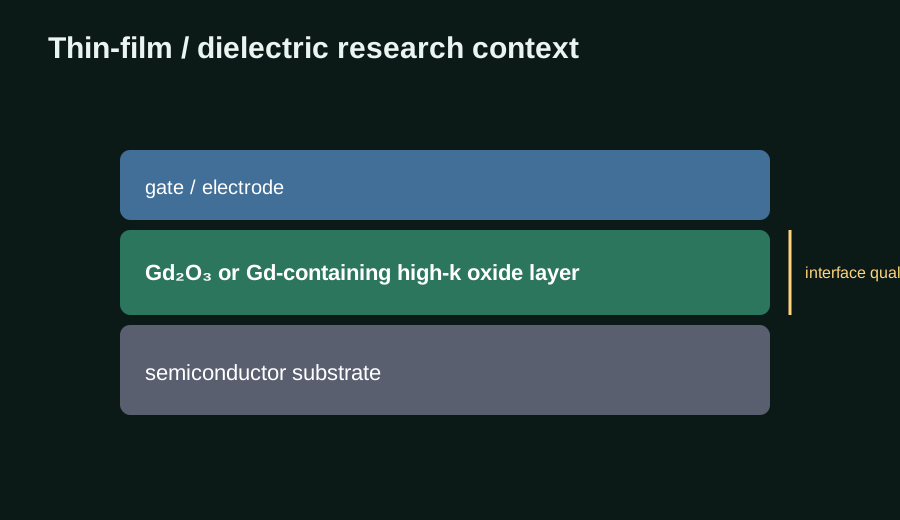
Why Gd-containing oxides are studied
High-k dielectrics aim to provide high capacitance while maintaining a physically thicker insulating layer than an equivalent SiO₂ film. Rare-earth oxides have attracted research interest because of their dielectric properties, band alignment possibilities and thermal behavior. Studies have reported Gd₂O₃ films deposited by methods including atomic layer deposition.
Bulk powder data does not predict thin-film device performance
Electrical behavior depends on film stoichiometry, density, phase, thickness, roughness, interface traps, oxygen vacancies, precursor residues and annealing. A powder product specification is therefore not a thin-film specification.
What matters in a deposition program
- Deposition precursor volatility and reactivity.
- Substrate surface preparation and interfacial layer formation.
- Oxygen stoichiometry and carbon/halogen residues.
- Anneal temperature and atmosphere.
- Thickness uniformity and roughness.
- Dielectric constant, leakage current, hysteresis and breakdown behavior.
Where oxide powder may still fit
High-purity Gd₂O₃ can serve as a starting material for target fabrication, ceramic sources, synthesis of deposition precursors or other process-specific routes. The correct form — powder, pellet, target or precursor — should be specified before purchasing.
References
- PubChem. “Gadolinia / Gadolinium oxide (Gd₂O₃), CID 159427.” Molecular formula, molecular weight, identifiers and safety data. pubchem.ncbi.nlm.nih.gov.
- NIST Chemistry WebBook. “digadolinium trioxide.” Formula, molecular weight and CAS Registry Number. webbook.nist.gov.
- NIST Center for Neutron Research. “Neutron Scattering Lengths and Cross Sections.” Includes absorption cross sections for ¹⁵⁵Gd and ¹⁵⁷Gd. ncnr.nist.gov.
- U.S. Geological Survey. Mineral Commodity Summaries 2026 - Rare Earths. Supply and end-use context for rare-earth materials. usgs.gov.
- Thermo Fisher Scientific Chemicals. Gadolinium(III) oxide product specifications and SDS, CAS 12064-62-9. thermofisher.com.
- American Elements. Gadolinium oxide technical data including density and melting point. americanelements.com.
- Recent Progress in Gd-Containing Materials for Neutron Shielding Applications: A Review. Open-access review discussing Gd₂O₃ in glass, polymers, concrete and metals. PMC.
- Review on the synthesis, structural and photo-physical properties of Gd₂O₃ phosphors for various luminescent applications. Optik. ScienceDirect.
- Current Status and Future Aspects of Gadolinium Oxide Nanoparticles as Positive MRI Contrast Agents. Nanomaterials (2025). Research context and clinical-translation caveats. MDPI.
- Atomic Layer Deposition of Gd₂O₃ and Dy₂O₃. Chemistry of Materials. Thin-film structure and electrical-property research. ACS Publications.