Why gadolinium is different
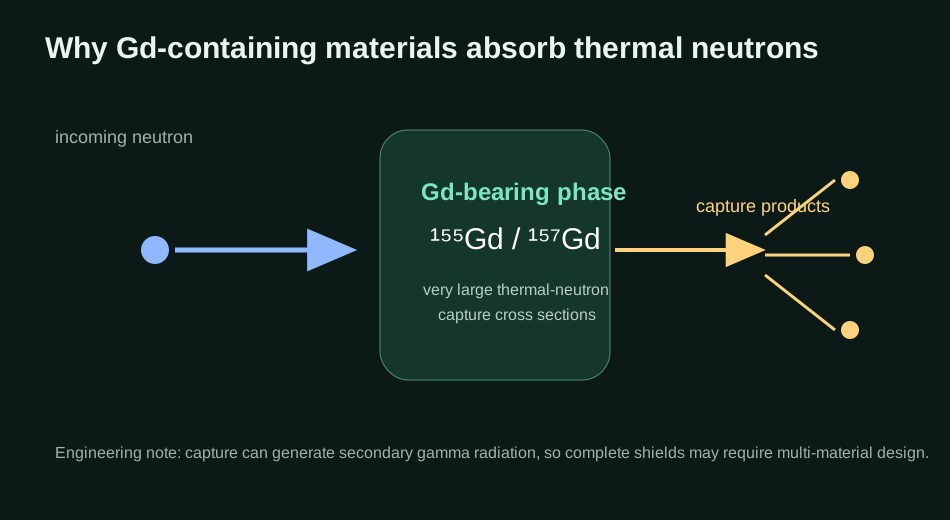
Natural gadolinium contains several stable isotopes. Two of them — ¹⁵⁵Gd and ¹⁵⁷Gd — have exceptionally large thermal-neutron absorption cross sections. NIST NCNR lists values on the order of tens of thousands and hundreds of thousands of barns, respectively. This is the physical reason Gd-containing materials appear in neutron shielding and neutron-detection research.
Why use Gd₂O₃ instead of metal gadolinium?
For many composite systems, the oxide offers a stable ceramic powder form that can be dispersed into glass, polymer, concrete or metal matrices. The optimum choice is application-specific: metallic Gd, Gd compounds, boron compounds and hydrogen-rich moderators each have different advantages.
The important engineering caveat: neutron capture is not the whole problem
Gadolinium capture events can produce gamma radiation and other secondary emissions. A material that reduces thermal-neutron transmission can therefore require additional gamma attenuation in a complete shield. Reviews of Gd-containing shielding materials specifically warn against evaluating neutron attenuation in isolation.
What to specify when buying Gd₂O₃ for shielding research
- Gd₂O₃ purity and impurity profile: enough to control unwanted phases and chemistry.
- Particle-size distribution: affects dispersion, viscosity, interfacial area and settling.
- Surface treatment: may matter in polymer or resin matrices.
- Loading basis: distinguish wt% Gd₂O₃ from wt% elemental Gd.
- Matrix and processing: thermoplastic, elastomer, epoxy, glass, concrete and metal routes impose different constraints.
- Homogeneity evidence: microscopy or compositional mapping is often more useful than nominal loading alone.
Research directions
Open literature describes Gd₂O₃ in glasses, concrete, natural rubber, SEBS and metal-matrix composites. The recurring tradeoff is between neutron capture and practical properties such as mechanical strength, flexibility, transparency, processability, cost and secondary-radiation management.
References
- PubChem. “Gadolinia / Gadolinium oxide (Gd₂O₃), CID 159427.” Molecular formula, molecular weight, identifiers and safety data. pubchem.ncbi.nlm.nih.gov.
- NIST Chemistry WebBook. “digadolinium trioxide.” Formula, molecular weight and CAS Registry Number. webbook.nist.gov.
- NIST Center for Neutron Research. “Neutron Scattering Lengths and Cross Sections.” Includes absorption cross sections for ¹⁵⁵Gd and ¹⁵⁷Gd. ncnr.nist.gov.
- U.S. Geological Survey. Mineral Commodity Summaries 2026 - Rare Earths. Supply and end-use context for rare-earth materials. usgs.gov.
- Thermo Fisher Scientific Chemicals. Gadolinium(III) oxide product specifications and SDS, CAS 12064-62-9. thermofisher.com.
- American Elements. Gadolinium oxide technical data including density and melting point. americanelements.com.
- Recent Progress in Gd-Containing Materials for Neutron Shielding Applications: A Review. Open-access review discussing Gd₂O₃ in glass, polymers, concrete and metals. PMC.
- Review on the synthesis, structural and photo-physical properties of Gd₂O₃ phosphors for various luminescent applications. Optik. ScienceDirect.
- Current Status and Future Aspects of Gadolinium Oxide Nanoparticles as Positive MRI Contrast Agents. Nanomaterials (2025). Research context and clinical-translation caveats. MDPI.
- Atomic Layer Deposition of Gd₂O₃ and Dy₂O₃. Chemistry of Materials. Thin-film structure and electrical-property research. ACS Publications.