◫
Identity & chemistry
Formula Gd₂O₃, molecular weight 362.50 g/mol, CAS 12064-62-9 and EC 235-060-9. The trivalent gadolinium state is the core chemistry behind most commercial descriptions.
Properties and identifiers →Understand gadolinium(III) oxide from the identifiers buyers search first to the specification details engineers actually need: purity basis, particle size, phase, impurities, neutron interaction, phosphor-host behavior, thin-film research, safety and procurement.
*Representative supplier technical value; always verify the lot specification and measurement basis.
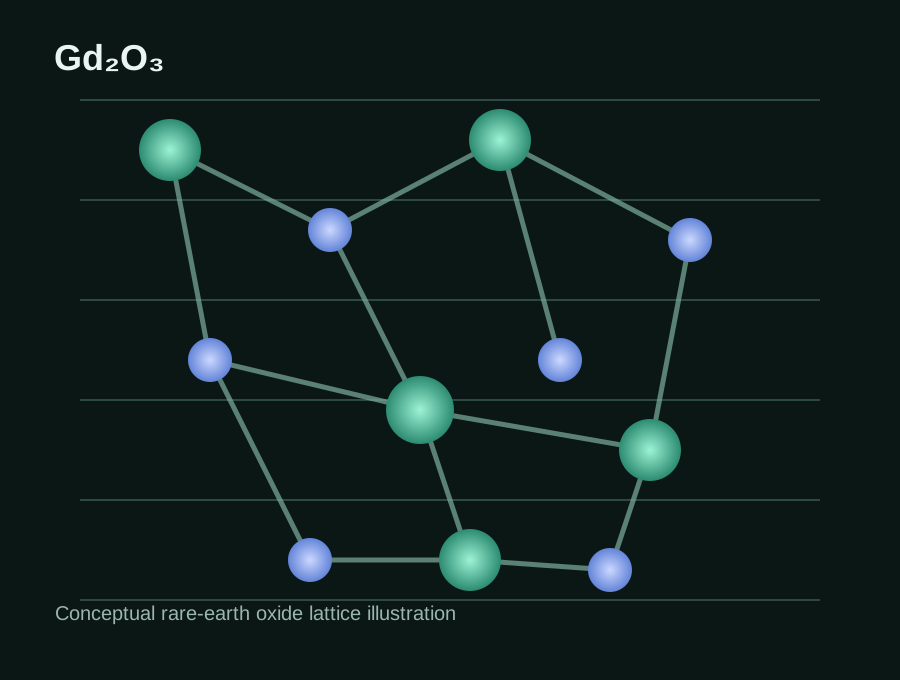
Gadolinium(III) oxide — commonly called gadolinium oxide or gadolinia — is an inorganic rare-earth oxide with formula Gd₂O₃. It is typically supplied as a white powder, and is used as a precursor or functional oxide in research and industrial material systems.
Formula Gd₂O₃, molecular weight 362.50 g/mol, CAS 12064-62-9 and EC 235-060-9. The trivalent gadolinium state is the core chemistry behind most commercial descriptions.
Properties and identifiers →Gd₂O₃ may act as a rare-earth precursor, phosphor host, ceramic/glass additive, neutron-absorbing phase, dielectric thin-film material or nanoscale magnetic/imaging research platform.
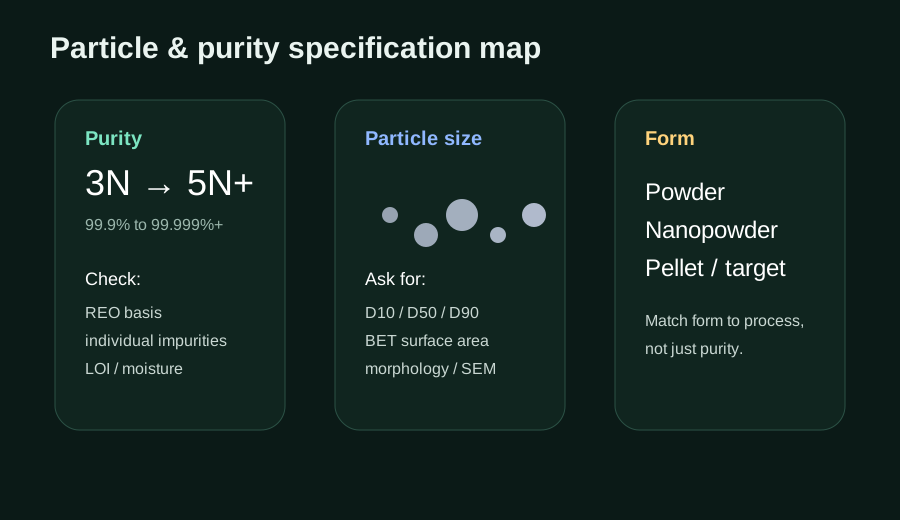
Application map →Purity, rare-earth impurity profile, D10/D50/D90, BET surface area, morphology, moisture/LOI and packaging can determine whether two nominally identical grades behave differently.
How to specify a grade →The value of gadolinium oxide is usually not “the oxide by itself” but the property it contributes to a larger material system.
| Parameter | Reference value / context | Why it matters |
|---|---|---|
| Formula | Gd₂O₃ | Distinguishes the sesquioxide from other gadolinium-oxygen species. |
| Molecular weight | 362.50 g/mol | Stoichiometry and conversion calculations. |
| CAS RN | 12064-62-9 | Supplier, SDS, regulatory and database matching. |
| Appearance | White powder (typical commercial description) | Basic incoming-goods check; not a purity test. |
| Density | ~7.407 g/cm³ (representative supplier value) | Useful in ceramic loading, composites and volume-to-mass estimates. |
| Melting point | ~2,420 °C (representative supplier value) | Signals refractory behavior; process temperatures are normally far lower. |
| Neutron interaction | ¹⁵⁵Gd and ¹⁵⁷Gd have exceptionally large thermal-neutron absorption cross sections | Explains Gd-containing neutron-absorbing materials; secondary gamma production must be engineered around. |
Data synthesis: PubChem, NIST, NIST NCNR, Thermo Fisher and American Elements. See the full reference library.
Use the specification builder to create a structured request rather than asking only for “gadolinium oxide 99.9%.”
Before launch, configure info@gadoliniumoxide.com as a working inbox or replace it in assets/js/site.js.
A printable PDF consolidating identity, properties, grades, application logic, safety, sourcing questions and references.
Source-linkedBuyer checklistEngineering caveats
Download PDF →